

Breakthrough in Emotional Mind Reading Photonic Vibration Perception System Achieves Stable Cross-Individual Recognition
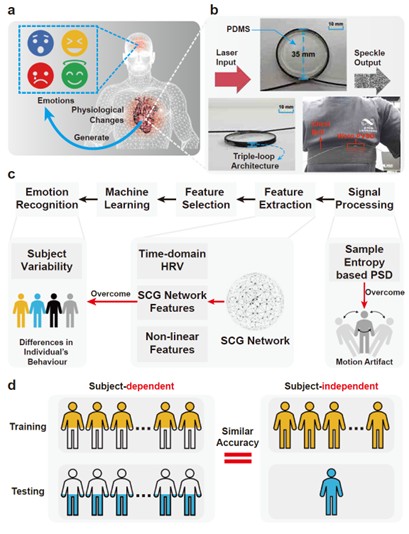
Figure 1 An overview of PCERS. a. Core principle of PCERS. Physiological changes are subsequently interpreted by the central nervous system, generating emotions and feelings. b. An overview of the PVSD. c. The signal processing and classification pipeline
A new publication DOI 10.29026/oet.2025.250010 discusses how a photonic vibration perception system achieves stable cross-individual recognition.
SHANNON, CLARE, IRELAND, February 5, 2026 /EINPresswire.com/ -- A new publication from Opto-Electronic Technology; DOI 10.29026/oet.2025.250010, discusses how a photonic vibration perception system achieves stable cross-individual recognition.
Emotions are a fundamental component of human cognition, decision-making, and social behavior, and they play an important role in applications such as mental health assessment, human–computer interaction, wearable devices, and intelligent healthcare. In recent years, emotion recognition based on physiological signals has attracted growing attention. Among these signals, cardiac activity is considered a particularly promising objective indicator, as it is closely associated with emotional arousal. However, a major challenge remains in practical applications: substantial inter-subject variability in physiological characteristics, signal patterns, and emotional responses. This variability often leads to a marked decline in performance when emotion recognition models are applied across subjects, significantly hindering their translation from laboratory studies to real-world use.
Meanwhile, conventional cardiac signal acquisition methods still face limitations in wearing comfort, resistance to motion artifacts, and long-term stability, making them less suitable for daily-life scenarios. With advances in photonic sensing and intelligent signal processing, novel sensing modalities and feature representations have emerged as promising solutions to these challenges. Consequently, developing emotion recognition approaches that ensure reliable signal acquisition while extracting emotion-related information that is robust to individual differences has become a key scientific issue in the field.
This study introduces a novel cardiac activity–based framework PCERS(Fig .1) for cross-subject emotion recognition, offering several important advances for affective computing and physiological signal analysis. First, a photonic sensing system is developed to capture seismocardiography signals in a non-invasive and highly sensitive manner. The system demonstrates fast response, long-term stability, and strong robustness to motion, providing a reliable foundation for emotion-related cardiac monitoring in practical scenarios. Second, a sample entropy–based signal processing strategy is employed to characterize the intrinsic complexity of cardiac signals. This approach effectively suppresses motion-induced interference while preserving emotion-relevant dynamics, resulting in more accurate and robust cardiac activity assessment under both static and dynamic conditions.
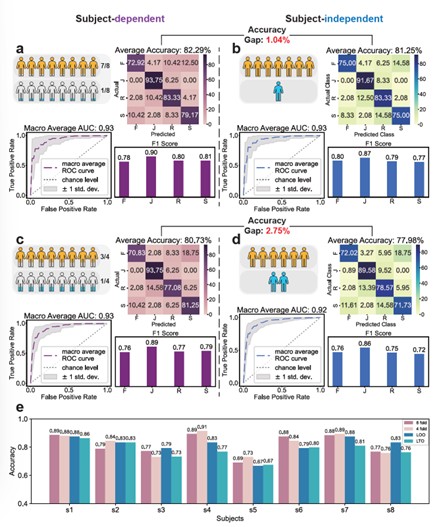
Most importantly, the study introduces a complex network–based representation of cardiac signals for emotion recognition. Network topological features derived from these signals exhibit clear differences between emotional states while remaining highly consistent across individuals. This subject-invariant property directly addresses a longstanding challenge in cross-subject emotion recognition. As a result, the proposed system achieves strong performance under subject-independent evaluation, (Fig .2) substantially reducing the performance gap between subject-dependent and cross-subject emotion recognition. These findings highlight the potential of the proposed framework to support practical, real-world emotion recognition applications.
This work was supported by the National Key Research and Development Program of China (Grant No. 2022YFE0140400), the National Natural Science Foundation of China (Grant Nos. 62405027, 62111530238, 62003046), the Major Scientific Research Project Incubation Fund of Beijing Normal University at Zhuhai (Grant No. ZHPT2023007), the Guangdong Special Support Program for Young Top-notch Talent (Grant No. 2024TQ08A610), and the Tang Chung Ying Foundation “Tang Scholar” award.
Keywords: photonic sensing, emotion recognition, machine learning, subject-invariant
# # # # # #
Rui Min, Principle Investigator and Doctoral Supervisor with the College of Arts and Sciences at Beijing Normal University at Zhuhai. His primary research interests include biomedical photonics, brain-computer interfaces, and wearable devices. He has been recognized as a Young Top-Notch Talent under the Guangdong Special Support Program, listed among the World's Top 2% Most-Cited Scientists (for three consecutive years), honored as a Tang Chung Ying Foundation “Tang Scholar,” and holds senior membership in IEEE and OPTICA. He serves as an editorial board member for Optics Express, IEEE Sensors Journal, Frontiers in Physics, and the Chinese journal Opto-Electronic Engineering. He has led several key research projects, including those under the National Key Research and Development Program (International Cooperation) and the National Natural Science Foundation of China (Youth and International Programs). Based on his research outcomes, he has published over 170 papers in internationally renowned journals and conferences such as Opto-Electronic Advances, with citations exceeding 4,200. Several of his papers have been featured as journal covers, selected as highly cited articles, or recommended by editors. His work has been highlighted by over ten internationally recognized academic media outlets, including IEEE Spectrum and EurekAlert.
# # # # # #
Opto-Electronic Technology (OET) is an international, peer-reviewed and open access English language journal. OET publishes reviews, research articles and letters covering engineering technologies and applications of optics, photonics and optoelectronics.
# # # # # #
More information: https://www.oejournal.org/oet/en/
Editorial Board: https://www.oejournal.org/oet/en/editorial_board/oetEditorialBoard
All issues available in the online archive (https://www.oejournal.org/oet/archive_list_en)
Submission of OET may be made using ScholarOne (https://mc03.manuscriptcentral.com/oet)
ISSN (Print) 2097-6003
CN 51-1811/O4
Contact Us: oet@ioe.ac.cn
Twitter: @OptoElectronAdv (https://twitter.com/OptoElectronAdv?lang=en)
WeChat: OE_Journal
# # # # # #
Long YK, Min R, Xiao K, et al. Decoding subject-invariant emotional information from cardiac signals detected by photonic sensing system. Opto-Electron Technol 1, 250010 (2025). DOI: 10.29026/oet.2025.250010
Opto-Electronic Technology Editorial Office
Opto-Electronic Technology
123456789
email us here
Legal Disclaimer:
EIN Presswire provides this news content "as is" without warranty of any kind. We do not accept any responsibility or liability for the accuracy, content, images, videos, licenses, completeness, legality, or reliability of the information contained in this article. If you have any complaints or copyright issues related to this article, kindly contact the author above.
