

Electric-Field-Induced Second-Harmonic Generation Paves the Way for Next-Generation Nonlinear Photonics
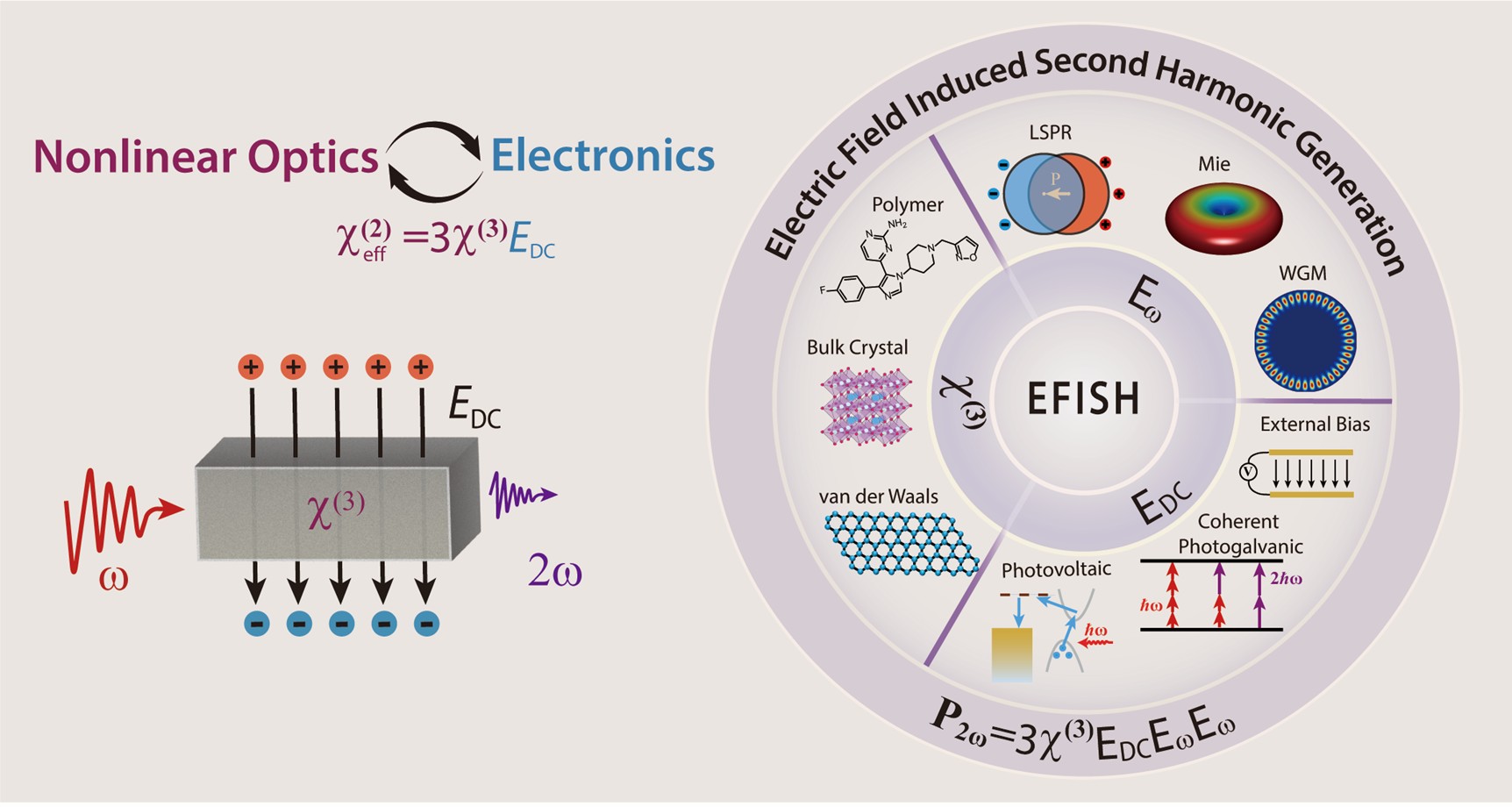
Fig. 1: Schematic overview of the key topics covered in this review. The EFISH effect emerges from the intimate coupling between electronic dynamics and nonlinear photonic. Depending on the EFISH functionality, the research can be categorized in to three
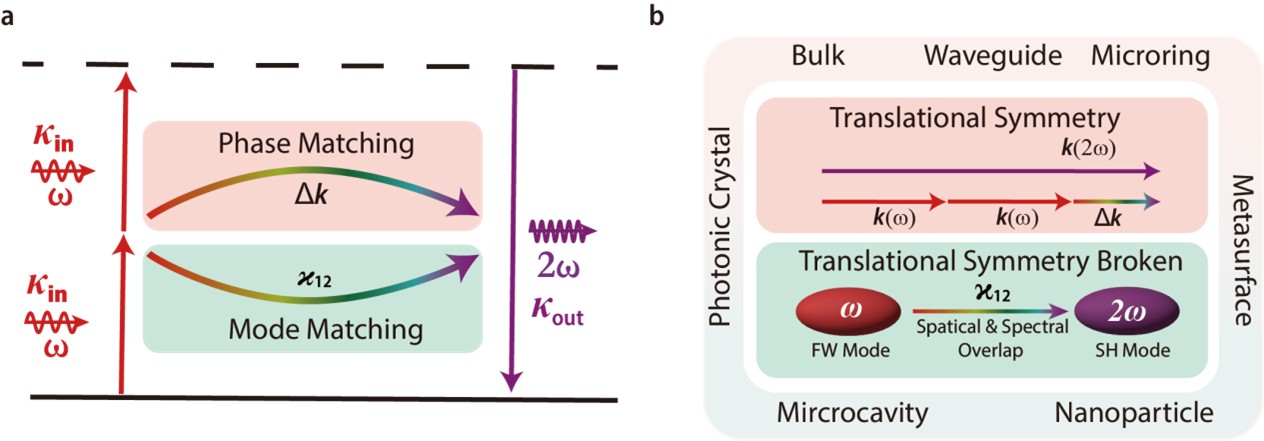
Fig. 2: Fundamentals of SHG. (a) Schematic energy-level diagram illustrating SHG. Efficient nonlinear harmonic generation requires both phase matching and mode matching. (b) Illustration of phase versus mode matching based on translational symmetry. In sy
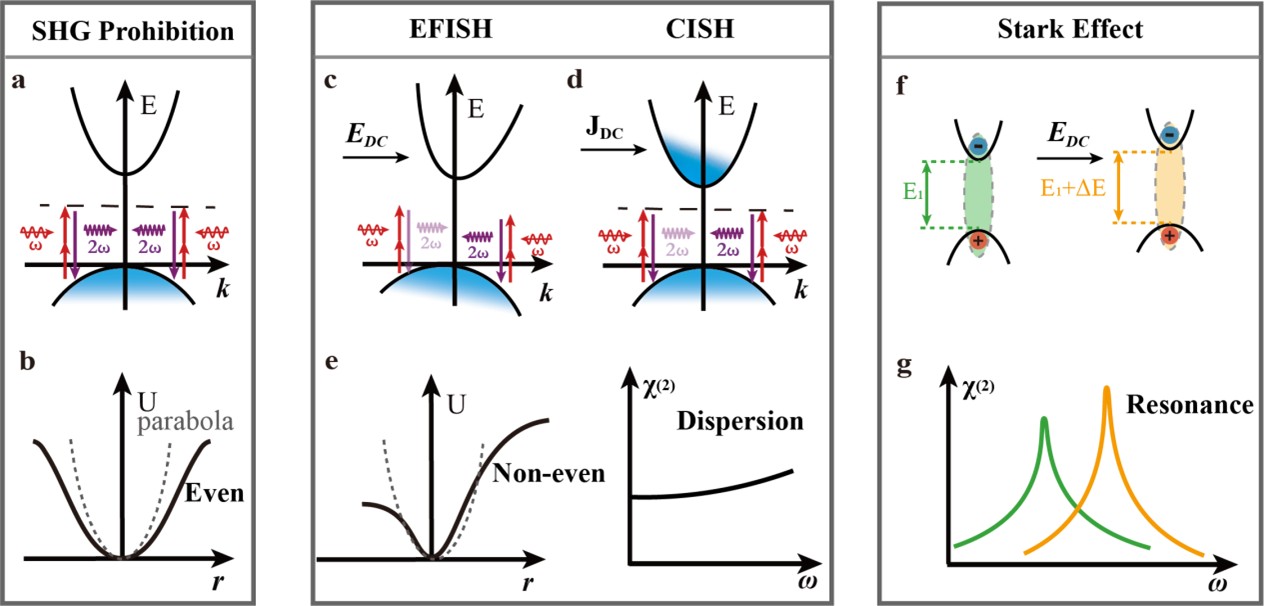
Fig. 3: Distinct mechanisms of EFISH, CISH, and QCSE. (a, b) In centrosymmetric materials, symmetric electron distribution in momentum space (blue area), corresponding to an even potentials in real space, leads to mutually cancelling second-harmonic polar
A new publication DOI 10.29026/oea.2026.250193 discusses electric-field-induced second-harmonic generation paves the way for next-generation nonlinear photonics
SHANNON, CLARE, IRELAND, February 5, 2026 /EINPresswire.com/ -- A new publication from Opto-Electronic Advances; DOI 10.29026/oea.2026.250193, discusses how electric-field-induced second-harmonic generation paves the way for next-generation nonlinear photonics.
Nonlinear optics stands as a cornerstone of modern photonics. Among its phenomena, Second-Harmonic Generation (SHG)—the most fundamental second-order nonlinear process—plays an indispensable role in fields such as laser frequency conversion, microscopic imaging, quantum light sources, and optical communication. Since the initial observation of SHG in quartz crystals by Franken et al. in 1961, the field has witnessed burgeoning development. From a physical standpoint, SHG originates from the nonlinear polarization generated during light-matter interaction, a process that imposes stringent requirements on the crystal symmetry of the material. Under the electric-dipole approximation, the intrinsic second-order nonlinear susceptibility χ^((2)) exists exclusively in non-centrosymmetric materials, such as Lithium Niobate (〖LiNbO〗_3) and Gallium Arsenide (GaAs).
However, this fundamental physical constraint has constituted a substantial obstacle to the advancement of silicon photonics. As mainstream materials for integrated optoelectronics, Silicon (Si), Silica (〖SiO〗_2), and Silicon Nitride (〖Si〗_3 N_4) are limited by their centrosymmetric crystal structures. Consequently, their bulk intrinsic second-order nonlinear coefficients are zero, theoretically rendering them incapable of generating SHG. To realize second-order nonlinear functionalities in these CMOS-compatible materials, researchers have historically relied on complex approaches, such as heterogeneous integration, surface/interface effects, or strain engineering. However, these methods often face challenges regarding low efficiency and fabrication complexity.
In this context, the Electric-Field-Induced Second-Harmonic Generation (EFISH) effect has garnered renewed and widespread attention within the academic community as an ingenious "symmetry-breaking" strategy. The essence of EFISH lies in the application of a static electric field (DC field) to the material, which induces a distortion in the originally symmetric electronic potential, thereby breaking the material's spatial inversion symmetry. This external-field-induced symmetry breaking generates an effective second-order nonlinear susceptibility "χ" _"eff" ^"(2)" "=" "χ" ^"(3)" "E" _"DC" , where "χ" ^"(3)" representing the material's intrinsic third-order nonlinear susceptibility. This mechanism not only enables the realization of SHG in centrosymmetric materials like silicon but, more importantly, introduces a tunable degree of freedom: the electric field. By altering the applied voltage or utilizing optical rectification fields, the intensity, phase, and even the polarization state of the nonlinear signal can be dynamically modulated. This characteristic provides a novel physical foundation for the realization of electrically controlled nonlinear metasurfaces, reconfigurable photonic chips, and emerging carrier dynamics probing techniques, serving as a core driving force for the development of next-generation intelligent, tunable nonlinear photonic devices.
Keywords: EFISH, metasurface, microresonator, vdW materials, nonlinear nanophotonics, CPE
# # # # # #
Opto-Electronic Advances (OEA) is a high-impact, open access, peer reviewed SCI journal with an impact factor of 22.4 (Journal Citation Reports 2024). OEA has been indexed in SCI, EI, DOAJ, Scopus, CA and ICI databases, and expanded its Editorial Board to 41 members from 17 countries.
# # # # # #
This review was authored by a joint research team from the Qingdao Innovation and Development Base of Harbin Engineering University, the College of Physics and Optoelectronic Engineering at Harbin Engineering University, and the School of Physics and Engineering at ITMO University. The corresponding author, Professor Andrey Bogdanov, is a distinguished expert in the field of nanophotonics. His primary research interests encompass all-dielectric metasurfaces, Mie resonance theory, Bound States in the Continuum (BIC), and non-Hermitian photonics. Professor Bogdanov possesses profound expertise in exploiting high-Q resonant states to enhance light-matter interactions. The collaborative team has published numerous high-impact papers in premier international journals, including Science and Physical Review Letters. They maintain active international collaborations and continue to lead frontier exploration in the fields of nonlinear metasurfaces and topological photonics.
# # # # # #
More information: http://www.oejournal.org/oea
Editorial Board: https://www.oejournal.org/oea/en/editorial_board/gdjzEditorialBoard
All issues available in the online archive (http://www.oejournal.org/oea/archive).
Submissions to OEA may be made using ScholarOne (https://mc03.manuscriptcentral.com/oea).
ISSN: 2096-4579
CN: 51-1781/TN
Contact Us: oea@ioe.ac.cn
Twitter: @OptoElectronAdv (https://twitter.com/OptoElectronAdv?lang=en)
WeChat: OE_Journal
# # # # # #
Fan HK, Proskurin A, Song MZ et al. Electric-field-induced second-harmonic generation. Opto-Electron Adv 9, 250193 (2026). DOI: 10.29026/oea.2026.250193
Opto-Electronic Advances Editorial Office
Opto-Electronic Advances
oea@ioe.ac.cn
Legal Disclaimer:
EIN Presswire provides this news content "as is" without warranty of any kind. We do not accept any responsibility or liability for the accuracy, content, images, videos, licenses, completeness, legality, or reliability of the information contained in this article. If you have any complaints or copyright issues related to this article, kindly contact the author above.
