

Noise-free full-color holography under incoherent ordinary light
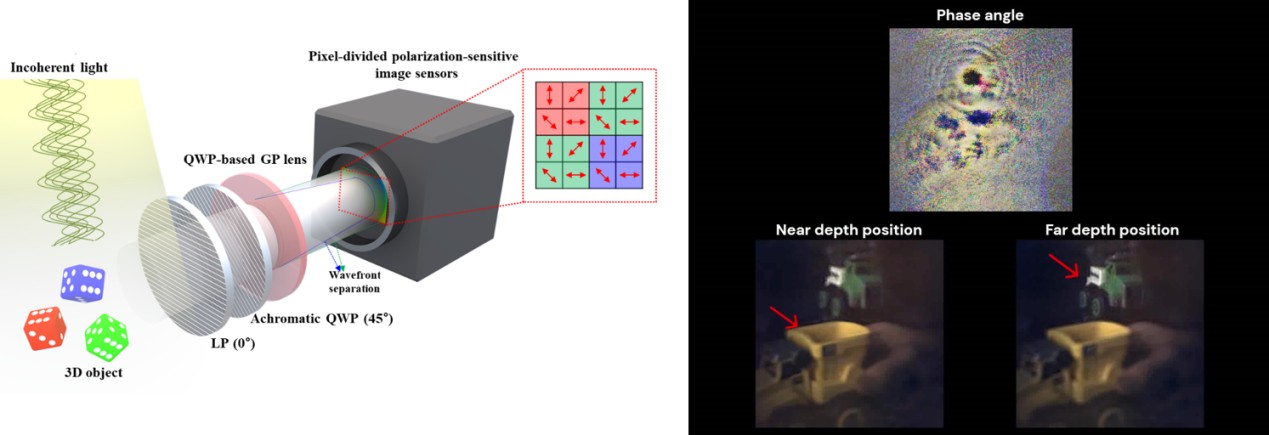
QWP-based GP-SIDH architecture for artifact-suppressed full-color holography under broadband incoherent illumination: schematic overview (left) and video-rate phase retrieval with high-fidelity depth-resolved reconstruction frames (right).
A new publication from Opto-Electronic Advances; DOI 10.29026/oea.2026.250149, discusses a quarter-wave geometric-phase route to practical 3D imaging.
SHANNON, CLARE, IRELAND, February 5, 2026 /EINPresswire.com/ -- A new publication from Opto-Electronic Advances; DOI 10.29026/oea.2026.250149, discusses a quarter-wave geometric-phase route to practical 3D imaging.
Digital holography captures more than a conventional 2D photograph. While an ordinary camera records only the intensity pattern of light, a digital holography system records information from light interference that allows the phase of the light field to be recovered as well. Access to phase is powerful because it enables wavefront reconstruction, which in turn allows computational refocusing or depth map reconstruction after capture, depth sectioning of objects located at different distances, and quantitative analysis that is difficult to achieve with intensity-only imaging. These capabilities make holography attractive for three-dimensional (3D) imaging, inspection, and scientific measurements.
In many classical implementations, digital holography relies on laser illumination. Lasers provide high coherence, which makes it easier to form clear interference patterns that encode phase. However, laser-based holography is not always ideal for practical deployment. Laser sources can add cost and bulk, and they may impose safety and alignment constraints. In addition, coherent illumination often produces speckle, a grainy pattern caused by random interference from rough surfaces and scattering in the optical path. Speckle can degrade image quality and complicate full-color imaging, particularly when the goal is to obtain clean reconstructions in realistic environments.
To address these limitations, researchers have developed holographic methods that operate under spatially incoherent illumination, such as LEDs or broadband white light. Self-interference incoherent digital holography (SIDH) is a representative approach. Instead of depending on long-range coherence between two separate beams, SIDH forms the required interference through a compact self-interference configuration. Because the illumination is incoherent, the method can be more compatible with everyday light sources and can also avoid the speckle issues that typically accompany laser-based coherent imaging. This makes SIDH appealing as a route toward robust and practical holographic imaging systems.
Prof. Hak-Rin Kim’s research group at Kyungpook National University in Republic of Korea focuses on compact photonic systems that translate wavefront-level control into practical imaging capabilities. A central motivation is the growing need for three-dimensional (3D) visual information in devices that must remain lightweight, robust, and cost-effective. While conventional cameras capture only intensity, wavefront imaging technologies aim to recover phase as well, enabling computational refocusing, depth sectioning, and quantitative analysis. These functions are increasingly relevant across optical inspection, biomedical imaging, and emerging visual computing platforms where accurate 3D content acquisition is valuable.
Digital holography is a representative wavefront imaging technique, but classical laser-based holography can be difficult to deploy outside controlled laboratory settings. Beyond the cost and alignment burden, coherent illumination often introduces speckle and sensitivity to environmental disturbances, which can degrade perceived image quality and limit stable operation. For full-color holography, the challenge becomes even greater because color channels must remain consistent across the visible spectrum. If the interference process is not well controlled for different wavelengths, reconstructions can exhibit channel-dependent artifacts that compromise both fidelity and reliability.
Self-interference incoherent digital holography (SIDH) offers an attractive pathway toward practical holographic imaging because it can operate under spatially incoherent illumination such as LEDs or broadband light. By forming interference through a compact self-interference configuration, SIDH reduces reliance on long-range coherence and can be more compatible with real-world illumination conditions. This architecture is also well aligned with the goal of stable imaging in less controlled environments, where minimizing coherence-related noise sources and maintaining robustness are essential.
At the same time, achieving high-fidelity full-color performance in a compact SIDH platform is not a straightforward extension. Many compact holographic designs rely on geometric-phase (GP) optics for wavefront control, because GP elements can be thin, lightweight, and compatible with compact optical modules. However, conventional GP-based holographic architectures, especially those relying on half-waveplate GP elements, can suffer from wavelength-dependent residual components. In a full-color setting, those residual terms may generate unintended interference contributions that manifest as color-dependent artifacts in reconstructed images. In other words, the limiting factor becomes optical in nature: if the wavefront formation itself is contaminated, reconstruction quality is constrained regardless of subsequent processing.
The importance of the present work lies in resolving this bottleneck through an architectural redesign based on quarter-waveplate (QWP) geometric-phase optics. The reported QWP-based GP-SIDH strategy is designed so that the interference remains fundamentally a two-wave process across the visible spectrum under broadband incoherent illumination. The non-diffracted component provides a stable reference wave, while a single diffracted component carries the object information. By preventing the formation of additional unintended wavefront contributions that can arise in conventional half-waveplate-based GP implementations, the approach suppresses color-dependent interference artifacts and preserves spectral consistency across red, green, and blue channels.
From a broader perspective, the work highlights a key design principle for computational imaging: the most scalable route to reliable performance often begins with improving the physical formation of the measured wavefront, not merely post-processing its artifacts. By combining incoherent self-interference holography with a QWP-based geometric-phase wavefront control strategy, the reported platform advances laser-free full-color holography toward practical use. The ability to deliver stable, high-fidelity, depth-resolved reconstructions from video-rate measurements suggests a pathway to portable holographic cameras and compact 3D imaging modules that can operate under broadband illumination while maintaining trustworthy color and depth information.
Keywords: self-interference incoherent digital holography, digital holography, geometric phase lens, polarization interference, holographic imaging
# # # # # #
Prof. Hak-Rin Kim’s research group at Kyungpook National University in Republic of Korea develops photonic and electro-optic technologies that bridge wavefront engineering, computational imaging, and practical imaging and display modules. With an emphasis on polarization-engineered wavefront control and system-level integration, the group investigates geometric-phase (GP) optics, polarization-sensitive imaging architectures, and holography-based techniques that enable compact, robust, and information-rich imaging beyond conventional intensity cameras. A recurring goal is to translate wavefront-level control into deployable systems that operate under realistic illumination conditions while remaining compatible with scalable fabrication and compact hardware.
A major thrust of the group’s recent work lies in GP optics for AR/VR/XR and related near-eye architectures, where thin polarization-driven elements such as GP lenses and prisms offer powerful wavefront functions in lightweight form factors. In parallel, the group has a strong track record in liquid-crystal (LC) optics and polarization switching for 3D display platforms, including switchable optical elements and polarization-based multiplexing approaches that support multi-view or depth-selective presentation. By considering both GP-based and LC-based routes, the team aims to deliver practical design choices across different device constraints, such as form factor, efficiency, color fidelity, and system robustness.
Methodologically, the team’s work spans theoretical modeling of polarization and wavefront interference, optical design of birefringent and thin-film elements, and experimental validation using camera systems and polarization-resolved sensors. By combining optical innovation with computational reconstruction, the group develops platforms enabling digital refocusing, depth-resolved 3D reconstruction, and high-fidelity color imaging. The group also collaborates with external research institutes and industry partners to accelerate the transition from laboratory demonstrations to prototypes, connecting optics, electronics, and algorithms to broaden the impact of modern holography and polarization photonics in emerging imaging and display technologies.
# # # # # #
Opto-Electronic Advances (OEA) is a high-impact, open access, peer reviewed SCI journal with an impact factor of 22.4 (Journal Citation Reports 2024). OEA has been indexed in SCI, EI, DOAJ, Scopus, CA and ICI databases, and expanded its Editorial Board to 41 members from 17 countries.
# # # # # #
More information: http://www.oejournal.org/oea
Editorial Board: https://www.oejournal.org/oea/en/editorial_board/gdjzEditorialBoard
All issues available in the online archive (http://www.oejournal.org/oea/archive).
Submissions to OEA may be made using ScholarOne (https://mc03.manuscriptcentral.com/oea).
ISSN: 2096-4579
CN: 51-1781/TN
Contact Us: oea@ioe.ac.cn
Twitter: @OptoElectronAdv (https://twitter.com/OptoElectronAdv?lang=en)
WeChat: OE_Journal
# # # # # #
Lee JW, Seo JH, Shin JY et al. High-fidelity full-color self-interference incoherent digital holography via quarter-wave geometric phase optics. Opto-Electron Adv 9, 250149 (2026). DOI: 10.29026/oea.2026.250149
Opto-Electronic Advances Editorial Office
Opto-Electronic Advances
oea@ioe.ac.cn
Legal Disclaimer:
EIN Presswire provides this news content "as is" without warranty of any kind. We do not accept any responsibility or liability for the accuracy, content, images, videos, licenses, completeness, legality, or reliability of the information contained in this article. If you have any complaints or copyright issues related to this article, kindly contact the author above.
