

What regional data tell us about the euro area Phillips curve
By Anna Beschin, Joan Paredes, Gaetano Polichetti and Théodore Renault[1]
Using regional data for 11 euro area countries from 1999 to 2023, instead of country-level data, we find that inflation still responds to economic slack, but this relationship is more modest and largely shaped by inflation expectations. This implies that traditional demand-side central bank policies may have limited direct effects on inflation, highlighting that anchoring expectations is essential for effective monetary policy transmission.
A new approach using regional data
The relationship between inflation and economic slack, shown by the Phillips curve, has long been a cornerstone of economic policymaking. A steep Phillips curve suggests that inflation responds strongly to developments in economic activity, while a flatter curve indicates weaker sensitivity – and therefore greater challenges for central banks in their efforts to steer inflation by adjusting interest rates.
Our work provides new evidence on the euro area Phillips curve by exploiting a rich dataset covering 168 regions across 11 euro area countries from 1999 to 2023.[2] In Eurostat’s Nomenclature of Territorial Units for Statistics (NUTS), these regions correspond to the NUTS-2 classification level, such as the Regioni in Italy and the Länder in Austria. The number of regions varies considerably across countries, ranging from 38 regions in Germany to three regions in Ireland.
Unlike previous euro area studies, which typically rely on country-level data, our regional approach offers a key advantage: there is substantially more variation in the data (see, for example, Eser et al., 2020), which helps identify the relationship between inflation and economic slack (McLeay and Tenreyro, 2019; Hazell et al., 2022; Smith et al., 2025). Our analysis uses regional unemployment rates as the measure of economic slack and the GDP deflator as the measure of changes in regional prices.
We exploit variation in local labour market conditions across regions while controlling for country-wide influences that affect all regions simultaneously. This approach is particularly relevant for the euro area, where labour market conditions vary not only across countries, but also substantially within them. Chart 1, panel a), illustrates significant dispersion in unemployment rates within countries, with rates in many regions deviating from the respective national averages by several percentage points. These within-country differences challenge the assumption that countries are internally uniform and highlight the importance of exploiting regional variation to estimate the Phillips curve.
Chart 1
Within-country dispersion
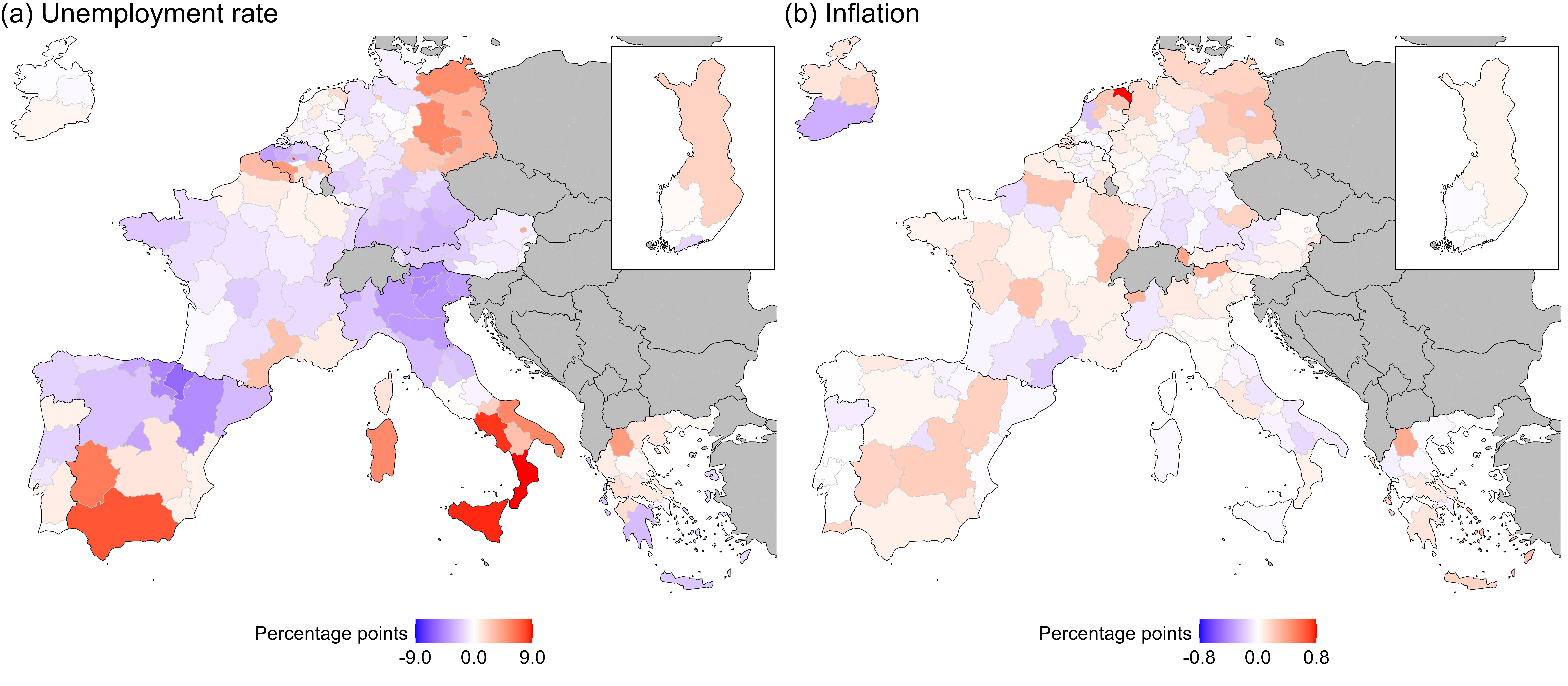
Notes: The figures show the within-country dispersion in unemployment rates and inflation for 11 euro area countries, averaged over 1999-2023. The within-country dispersion is measured as the difference between regional and national unemployment rates and inflation respectively. The data are expressed in percentage points.
Our regional dataset allows us to control for time-invariant regional characteristics (“region fixed effects”) that could otherwise obscure the relationship between unemployment and inflation. For example, regional unemployment rates are highly persistent: regions with elevated unemployment at the start of the sample tend to remain high-unemployment regions throughout the period. To account for these structural differences across regions, we include region fixed effects. We also include “time fixed effects” to control for developments common to all euro area regions.
By controlling for time-invariant regional characteristics and for shocks common to all euro area regions, we isolate the region-specific relationship between inflation and economic slack. When we include region and time fixed effects, we find a slope of -0.19, indicating that inflation continues to respond to changes in regional unemployment, consistent with the Phillips curve.
The value of regional data becomes clear when comparing our estimates with country-level studies. Eser et al. (2020), for example, estimate a Phillips curve slope of -0.01 using country-level data with country fixed effects and time fixed effects. Using regional data under comparable controls, we find a slope of -0.10 – around ten times larger.
What role do inflation expectations play?
The estimated relationship becomes even weaker once we include inflation expectations at the national level. To do so, we first follow McLeay and Tenreyro (2019) by explicitly including professional forecasts of one-year ahead inflation expectations, which are applied uniformly to all regions within a country in a given year.[3] When these expectations are included in the estimations, the Phillips curve becomes noticeably flatter. Although inflation continues to respond to developments in unemployment, the magnitude of this response falls by roughly one-third compared with estimations that only control for regional characteristics and common euro area shocks.
However, professional forecasts capture only one dimension of inflation expectations. The expectations of households and firms may differ and may also influence inflation dynamics (Coibion et al., 2018). To capture broader national inflation expectations, we adopt an alternative approach that accounts for country-specific factors that evolve over time, including national inflation expectations (“country-time fixed effects”). This has the advantage of capturing the aggregate influence of expectations on inflation without relying on a specific measure.
When region and country-time fixed effects are included, the estimated relationship between inflation and regional economic slack weakens, approaching zero though remaining statistically significant. Compared with a slope of -0.19 in the estimation with region and time fixed effects, controlling for inflation expectations reduces the estimated slope to -0.12, and it flattens further to -0.02 when expectations are accounted for through country-time fixed effects. Taken together, these results underscore a key point: properly accounting for inflation expectations is essential for accurately estimating the Phillips curve in the euro area. Whether expectations are controlled for explicitly through professional forecasts or implicitly through country-time fixed effects, the estimated slope of the Phillips curve flattens substantially.
Finally, we investigate whether the Phillips curve behaves differently when labour market conditions change. The question of whether the Phillips curve is better approximated by a linear or a non-linear relationship has also been at the forefront of recent policy discussions in the wake of the 2021-22 inflation surges, both in the United States and in the euro area (Kugler, 2025; Lane, 2024; Schnabel, 2025).
A visual representation of the data points to a roughly linear relationship at higher unemployment levels, but with a stronger inflation response and therefore a steeper Phillips curve when labour markets are particularly tight, suggesting possible non-linearities (Chart 2, panel a). However, this pattern is substantially weaker once region and time fixed effects are included and inflation expectations are properly accounted for (Chart 2, panel b). Using a threshold model, which looks at whether the relationship changes when a threshold is reached, we test whether inflation responds more strongly to slack when labour markets are particularly tight. Once we include professional forecasts, the evidence for a steeper Phillips curve at low levels of unemployment diminishes considerably. When we include country-time fixed effects, the non-linearity effectively disappears and the Phillips curve appears broadly linear. This suggests that apparent non-linearities may reflect shifts in inflation expectations rather than fundamental changes in how inflation responds to labour market tightness (Beaudry et al., 2025; Lenza et al., 2025).
Chart 2
Estimates of the slope of the Phillips curve when controlling for fixed effects
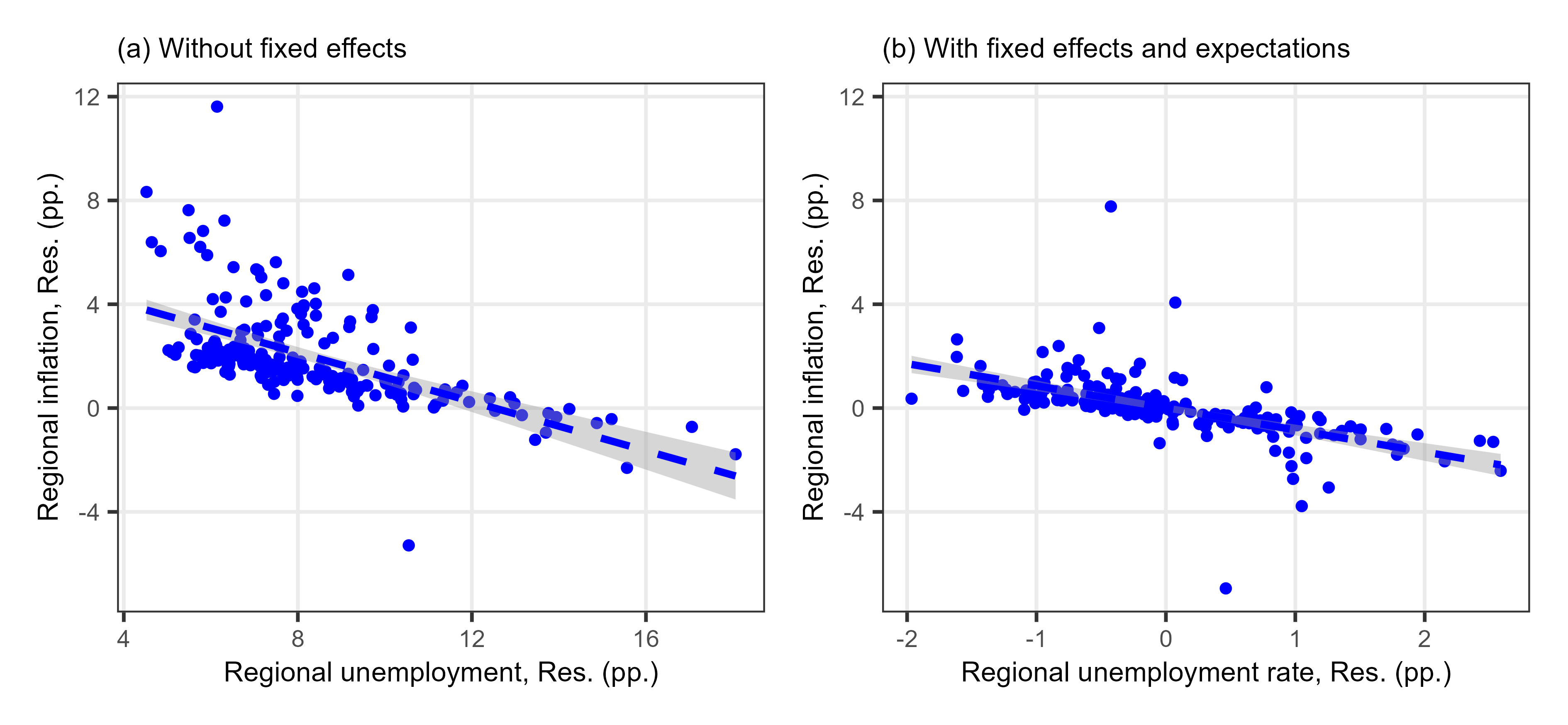
Notes: The figures show the slope of the Phillips curve from our baseline estimations. Panel a) plots the raw inflation data and the raw unemployment data, grouped into 200 bins of unemployment. Panel b) plots the binned residuals of inflation and unemployment against region and time fixed effects and controlling for national inflation expectations. The dashed lines represent the best linear fit for both estimations, the grey areas show the associated confidence intervals. The data are expressed in percentage points.
Concluding remarks and monetary policy implications
The Phillips curve in the euro area remains statistically significant but is relatively flat and linear once regional data on unemployment are used, and it becomes even flatter when national inflation expectations are properly accounted for. This finding has important implications for monetary policy.
A flatter Phillips curve means that changes in economic activity induce limited movements in inflation, reducing the effectiveness of interest rate adjustments in steering inflation through the demand channel of monetary policy transmission. At the same time, our results highlight the central role of inflation expectations in shaping inflation dynamics. This underscores the importance of a credible monetary policy framework and a strong commitment to the medium-term inflation target. In an environment where inflation is less responsive to economic slack, anchoring expectations becomes essential for effective monetary policy transmission.
References
Beaudry, P., Hou, C. and Portier, F. (2025), “On the fragility of the nonlinear Phillips curve view of recent inflation”, NBER Working Papers, No 33522.
Becker, S. O., Egger, P. H. and von Ehrlich, M. (2010), “Going NUTS: The effect of EU Structural Funds on regional performance”, Journal of Public Economics, Vol. 94(9-10), pp. 578–590.
Beschin, A., Paredes, J., Polichetti, G. and Renault, T. (2025), “The slope of the euro area price Phillips curve: evidence from regional data”, ECB Working Paper Series, No 3133, October.
Coibion, O., Gorodnichenko, Y. and Kamdar, R. (2018), “The Formation of Expectations, Inflation, and the Phillips Curve”, Journal of Economic Literature, Vol. 56(4) pp.1447–1491.
Eser, F., Karadi, P., Lane, P. R., Moretti, L. and Osbat, C. (2020), “The Phillips Curve at the ECB”, Manchester School, Vol. 88(S1) pp. 50–85.
Hazell, J., Herreño, J., Nakamura, E. and Steinsson, J. (2022), “The Slope of the Phillips Curve: Evidence from U.S. States”, The Quarterly Journal of Economics, Vol. 137(3), pp. 1299–1344.
Kugler, A. (2025), “Navigating Inflation Waves: A Phillips Curve Perspective: A speech at the Whittington Lecture, McCourt School of Public Policy, Georgetown University, Washington, D.C., February 20, 2025”, Technical Report, Board of Governors of the US Federal Reserve System.
Lane, P. R. (2024), “The 2021-2022 inflation surges and the monetary policy response through the lens of macroeconomic models”, SUERF Policy Note, No 364.
Lenza, M., Moutachaker, I. and Paredes, J. (2025), “Density forecasts of inflation: A quantile regression forest approach”, European Economic Review, Vol. 178, Article 105079.
McLeay, M. and Tenreyro, S. (2019), “Optimal Inflation and the Identification of the Phillips Curve”, NBER Macroeconomics Annual, Vol. 34(1), pp. 199–255.
Schnabel, I. (2025), “Keeping a steady hand in an unsteady world”, speech at the Hoover Monetary Policy Conference on “Finishing the Job and New Challenges”, Stanford University, 10 May 2025, Technical Report, European Central Bank.
Smith, S. C., Timmermann, A. and Wright, J. H. (2025), “Breaks in the Phillips Curve: Evidence From Panel Data”, Journal of Applied Econometrics, Vol. 40(2), pp. 131–148.
Legal Disclaimer:
EIN Presswire provides this news content "as is" without warranty of any kind. We do not accept any responsibility or liability for the accuracy, content, images, videos, licenses, completeness, legality, or reliability of the information contained in this article. If you have any complaints or copyright issues related to this article, kindly contact the author above.
