

Top industries and services news from Ireland
Provided by AGP
Active retinal projection augmented reality display via pixel-to-pixel collimation

Figure 1 ǀ Definition of passive and active retinal projection display. a, b The fundamental architecture of P-RPD (a) and A-RPD (b).
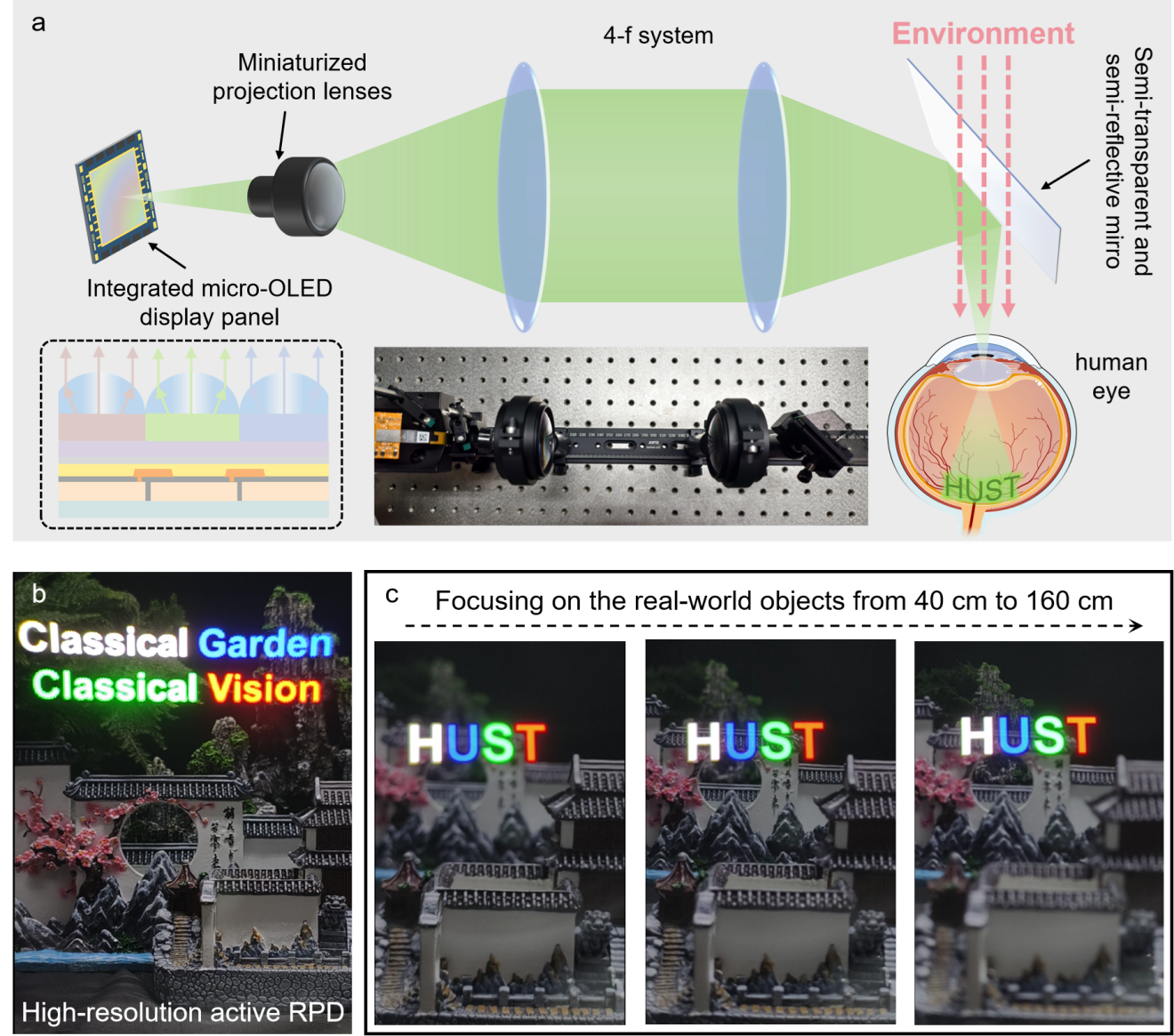
Figure 2 ǀ The practical construction of the microlenses-based A-RPD prototype. a The schematic diagram of the microlenses-based A-RPD prototype. The insets therein respectively show the schematic diagram of micro-OLEDs with in-situ integrated microlenses
SHANNON, CLARE, IRELAND, May 22, 2026 /EINPresswire.com/ -- Announcing a new publication from Opto-Electronic Advances; DOI 10.29026/oea.2026.250252
Visual perception is a critical pathway for humans to expand their cognition of the surroundings, driving the continuous advancement of display technologies from flat-panel displays to near-eye displays. Augmented reality (AR) display stands out as one of the most typical representatives in this evolution, serving as an interface to bridge the virtual and the real worlds. In the pursuit of next-generation AR displays, the human-centered philosophy encourages continuous efforts toward immersive, comfortable, and portable morphology. In recent years, substantial progress has been achieved in lightweight devices and the significantly mitigated “screen-door effect”. However, current mainstream AR displays rely on optical components such as waveguides to realize the extra-ocular virtual image projection, which introduces severe vergence‑accommodation conflict (VAC).
More than a century ago, James Clerk Maxwell observed that when light is focused at the pupil of the eye, a uniform bright spot is projected onto the retina, allowing the perception of corresponding information. This is Maxwellian-view principle. Retinal projection display technology builds on this principle and holds promise for resolving VAC. Specifically, optical elements can focus an image‑carrying beam into a spot at the pupil, which is then directly projected onto the retina. In 1980, R. H. Webb et al. invented the scanning laser ophthalmoscope (SLO) based on this concept and proposed that modulating the scanning laser beam could enable image display. In 1993, J. S. Kollin and colleagues at the University of Washington employed a laser source coupled with a horizontal scanner to generate images via beam scanning, successfully demonstrating image display and creating the world’s first retinal projection display prototype. In such systems, because the beam passes through the center of the pupil, the retinal imaging remains clear and unaffected by the eye’s accommodation to real‑world objects at different depths.
Over more than three decades of development, retinal projection devices have relied on lasers or readily collimated point sources to ensure that light can be efficiently focused into a spot. This architecture necessitates an additional image‑generation component to produce the displayed image, such as a micro‑electro‑mechanical system (MEMS), digital micromirror device (DMD), or liquid‑crystal‑on‑silicon (LCoS). This configuration shares drawbacks similar to those of conventional liquid crystal displays, including large volume, slow response speed, and potential eye‑safety risks associated with high‑power laser sources. Overcoming these limitations to realize retinal projection systems that better align with human needs remains a central focus.
This work here defines the conventional retinal projection systems as passive retinal projection displays (P‑RPD). Inspired by the evolution from passive to active display architectures, Prof. Jiajun Luo from Monolithically-integrated Optoelectronic Devices and System group (MODS) at Huazhong University of Science and Technology, in collaboration with Prof. Enguo Chen, proposed the concept of an active retinal projection display (A‑RPD). The feasibility of this concept stems from the continuous downscaling of light‑emitting diodes (LEDs) and their ability to be densely integrated as light‑source arrays on CMOS drivers. Such micro‑LED display chips provide an excellent platform for integrating emerging micro‑ and nano‑optical elements, enabling direct image output with collimated beams. This approach not only significantly reduces the space required for external image‑generation components (offering a more streamlined architectural design), but also preserves the intrinsic advantages of micro‑display chips, such as high response speed and high resolution. Compared with conventional P‑RPD systems, A‑RPD holds greater potential for realizing smaller, more comfortable, and laser‑free AR devices.
In this paper, the authors propose the concept of A-RPD with whose performance is highly impacted by the collimation of integrated light sources. This concept with simplified architecture is enabled by emerging AM microdisplay panels for their potential in the integration of image sources and collimated light sources. Based on this, they further derive the relationship between DOF and the exit pupil size influenced by the collimation of microdisplay panels. Authors also validated the derivation by simulating and demonstrating the A-RPD prototype with a balanced design and performance based on AM microdisplay panels collimated at the pixel level. The constructed A-RPD prototype enables clear retinal imaging wherever the human eye focuses on objects within the range from 40 cm to 160 cm. This work highlights the importance and superiority of A-RPDs achieved by collimated AM microdisplay panels and provides foundations for their further expansion in practical applications.
Currently, the A-RPD architecture remains a relatively concept enjoying its preliminary stage, and the prototype demonstrated in this work still offers considerable room for further investigation and improvement. This work also provides a detailed discussion of potential future development pathways, offering insights for practical applications. A key focus lies in the miniaturization, optimization, and innovative application of the various optical components within the overall system. In this regard, emerging diffractive optical elements hold substantial promise due to their unique integration advantages and superior light‑field control capabilities. Furthermore, because RPD systems require the beam to pass through the center of the pupil, the limited eyebox presents an unavoidable challenge. Fortunately, existing approaches such as eye‑tracking and viewpoint‑replication technologies can effectively mitigate or overcome this limitation. As the technology matures, the simplicity and integration‑friendly nature of the A-RPD architecture are expected to shine in applications such as transparent displays and contact‑lens displays.
Keywords: retinal projection display, augmented reality display, optical design, display
# # # # # #
Jiajun Luo is a professor at the Wuhan National Laboratory for Optoelectronics, Huazhong University of Science and Technology. He is a recipient of the National Science Fund for Outstanding Young Scholars and is recognized as a China–Korea Young Leader by the Society for Information Display (SID). His research focuses on emerging optoelectronic materials, devices, system architecture design, and integration. He has authored over 50 publications in journals including Nature, Nature Photonics, and Nature Reviews Materials, and has filed/been granted more than 20 Chinese invention patents. He has served as principal investigator for multiple projects, including grants from the National Natural Science Foundation of China, key national R&D programs, and major research initiatives in Hubei Province. His honors include the China’s Top 10 Optical Breakthroughs (2017, 2018, 2023), the Chinese Optical Society Outstanding Doctoral Dissertation Award, the Wang Daheng Optics Award, and the First Prize of Natural Science from the Chinese Society for Optical Engineering.
# # # # # #
Opto-Electronic Advances (OEA) is a high-impact, open access, peer reviewed SCI journal with an impact factor of 22.4 (Journal Citation Reports 2024). OEA has been indexed in SCI, EI, DOAJ, Scopus, CA and ICI databases, and expanded its Editorial Board to 41 members from 17 countries.
# # # # # #
More information: http://www.oejournal.org/oea
Editorial Board: http://www.oejournal.org/oea/editorialboard/list
All issues available in the online archive (http://www.oejournal.org/oea/archive).
Submissions to OEA may be made using ScholarOne (https://mc03.manuscriptcentral.com/oea).
ISSN: 2096-4579
CN: 51-1781/TN
Contact Us: oea@ioe.ac.cn
Twitter: @OptoElectronAdv (https://twitter.com/OptoElectronAdv?lang=en)
WeChat: OE_Journal
# # # # # #
Zhang X, Huang YL, Fan WY et al. Active retinal projection augmented reality display via pixel-to-pixel collimation. Opto-Electron Adv 9, 250252 (2026). DOI: 10.29026/oea.2026.250252
Opto-Electronic Advances Editorial Office
Opto-Electronic Advances
+86 591 2286 1222
email us here
Legal Disclaimer:
EIN Presswire provides this news content "as is" without warranty of any kind. We do not accept any responsibility or liability for the accuracy, content, images, videos, licenses, completeness, legality, or reliability of the information contained in this article. If you have any complaints or copyright issues related to this article, kindly contact the author above.
